
Keeping Your Baby Safe in Hot Weather: A Complete Guide for Parents
Everything you need to know about babies and heat, sun safety, hydration, sleep, and when to seek help, from Little Village Antenatal
British summers have changed. Heatwaves that were once rare are now a regular feature of the calendar, and temperatures that would have seemed extraordinary a decade ago are becoming increasingly familiar. For parents of young babies, a hot spell brings a specific and very real set of concerns.
Babies, particularly newborns and those under six months, cannot regulate their own body temperature effectively. They cannot tell you they are too hot. They cannot move themselves into the shade, kick off their covers, or reach for a drink of water. They are entirely dependent on you to keep them safe.
This guide covers everything you need to know, from how to recognise overheating, to safe sleep in warm weather, to feeding, sun safety, and when to seek medical help.
Why Babies Are Vulnerable to Heat
Adults regulate body temperature through a sophisticated system of sweating, vasodilation (widening of the blood vessels near the skin to release heat), and behavioural responses such as moving into shade, seeking cool air, and drinking fluids. Babies, particularly very young ones, have an immature thermoregulatory system. They sweat less efficiently, their surface area relative to body size is much larger, meaning they absorb heat from the environment more readily, and they cannot communicate discomfort or take action to cool themselves.
This means overheating can happen quickly in a young baby, and overheating is a risk factor for Sudden Infant Death Syndrome (SIDS), heat exhaustion, and dehydration.
The good news is that with the right knowledge, keeping your baby safe in hot weather is very manageable. Here is what you need to know.
What Temperature Is Too Hot for a Baby?
The recommended room temperature for a sleeping baby is between 16°C and 20°C. During a heatwave, maintaining this temperature range can be genuinely challenging, but knowing the target helps you work towards it.
For outdoor temperatures, there is no absolute threshold above which you must stay indoors, but the NHS advises keeping babies out of direct sunlight entirely, particularly between 11am and 3pm when UV rays are strongest and temperatures are at their peak.
A useful general rule: if it feels very hot to you, your baby is likely finding it even hotter. Babies feel the heat more intensely than adults do.
How to Tell if Your Baby is Too Hot
Checking your baby's temperature during hot weather is important, but many parents check in the wrong place. Your baby's hands and feet are naturally cooler than the rest of their body and are not a reliable guide to core temperature. Instead, check the back of the neck by feeling with the back of your hand. If it feels hot and sweaty, your baby is too warm. The tummy is also a more reliable indicator of core temperature than the hands or feet.
Signs that your baby may be overheating:
Skin that feels hot or looks flushed and red
Sweating, including damp hair or a sweaty neck and back
Rapid breathing
Restlessness or unusual irritability
Feeling limp or lethargic
Fewer wet nappies than usual, which is a sign of dehydration
Signs of heat exhaustion (seek medical help promptly):
High temperature (above 38°C in a baby under three months, above 39°C in a baby three to six months, as these temperatures always require urgent assessment)
Vomiting
Rapid, weak pulse
Cool, clammy skin despite being in a hot environment
Extreme lethargy or difficulty waking
Sunken fontanelle (the soft spot on the top of the head), which indicates dehydration
Signs of heatstroke (this is a medical emergency, call 999):
Very high temperature (40°C or above)
Hot, dry skin with no sweating despite being overheated
Rapid, strong pulse
Confusion or loss of consciousness
Seizure
If you are at all concerned that your baby may be suffering from heat exhaustion or heatstroke, do not wait. Call 111 for urgent advice or 999 in an emergency.
Keeping Your Baby Cool at Home
Managing Room Temperature
Keeping rooms cool during a heatwave requires active management, particularly if your home does not have air conditioning, which most UK homes do not.
Close curtains, blinds, and windows on the sunny side of the house before the temperature rises in the morning. Blackout blinds are particularly effective at blocking heat as well as light.
Open windows strategically. They can be opened in the morning before it gets hot, and again in the late evening when the outside temperature drops below the indoor temperature. Opening windows on opposite sides of the house creates cross-ventilation.
Fans can help, though a fan does not cool the air itself. It does increase air movement, which helps evaporative cooling as sweat evaporates from the skin. A fan should never be pointed directly at a baby for prolonged periods. Place it so it circulates air in the room rather than blowing directly onto your baby. You can place a bowl of iced water or frozen water bottles in front of the fan to help cool the air a little further.
Use a room thermometer to check the temperature regularly. These are inexpensive and invaluable in hot weather. Place it at the level your baby sleeps, not up on a shelf where heat collects.
Move your baby's sleep space if possible. Ground floor rooms and north-facing rooms tend to stay cooler than upper floors and south-facing rooms during hot weather.
Dressing Your Baby at Home
In hot weather, dress your baby in as little as is safe. A single layer of lightweight, breathable fabric such as a short-sleeved vest or babygro is usually appropriate when it is very warm indoors. Natural fabrics such as cotton are preferable to synthetic fabrics as they breathe better.
If the room temperature is above 26°C, your baby may be comfortable in just a nappy.
In terms of sleeping bags in hot weather, use a 0.5 tog for warm weather or a 1.0 tog if temperatures are moderate. If the room is very hot, a nappy and a light cellular blanket or muslin is sufficient. Never let your baby sleep without any covering at all if the temperature might drop during the night.
Cool Baths
A lukewarm bath, not a cold one, can be a very effective way of cooling a baby down. Use tepid water rather than cold, as very cold water can cause shock and cause blood vessels to constrict, which actually traps heat in the body. After the bath, do not rush to dress your baby. Allow them to air-dry naturally.
You can also use a damp flannel or muslin cloth on the back of the neck, wrists, and ankles, which are areas where blood vessels sit close to the surface, to help cool your baby gently.
Cooling Products
Several products are marketed for keeping babies cool in hot weather. Cooling mats are designed for babies and young children to lie on and work by absorbing body heat. They can be used during awake, supervised time but should not be used in the sleep space.
Car seat inserts and stroller liners are also available, as car seats and prams can trap heat significantly. Ensure any product you use is specifically designed for your car seat or pram model and does not compromise the safety of the restraint.
Avoid placing ice packs or frozen products directly against your baby's skin.
Safe Sleep in Hot Weather
Safe sleep guidance does not change in hot weather. The principles remain the same, but the application of those principles needs to adapt.
Always place your baby on their back on a firm, flat, clear surface. This does not change regardless of temperature.
Adjust bedding for the temperature. In very hot weather, a baby may sleep in just a nappy with a very light muslin.
Use the following as a guide:
Below 16°C 1 vest + sleepsuit + 2.5 tog sleeping bag or blanket layers
16 to 20°C 1 vest + sleepsuit + 2.5 tog sleeping bag
20 to 24°C 1 vest + sleepsuit + 1.0 tog sleeping bag
24 to 27°C 1 vest or short-sleeved bodysuit + 0.5 tog sleeping bag
Above 27°C Nappy only, or nappy with a light muslin
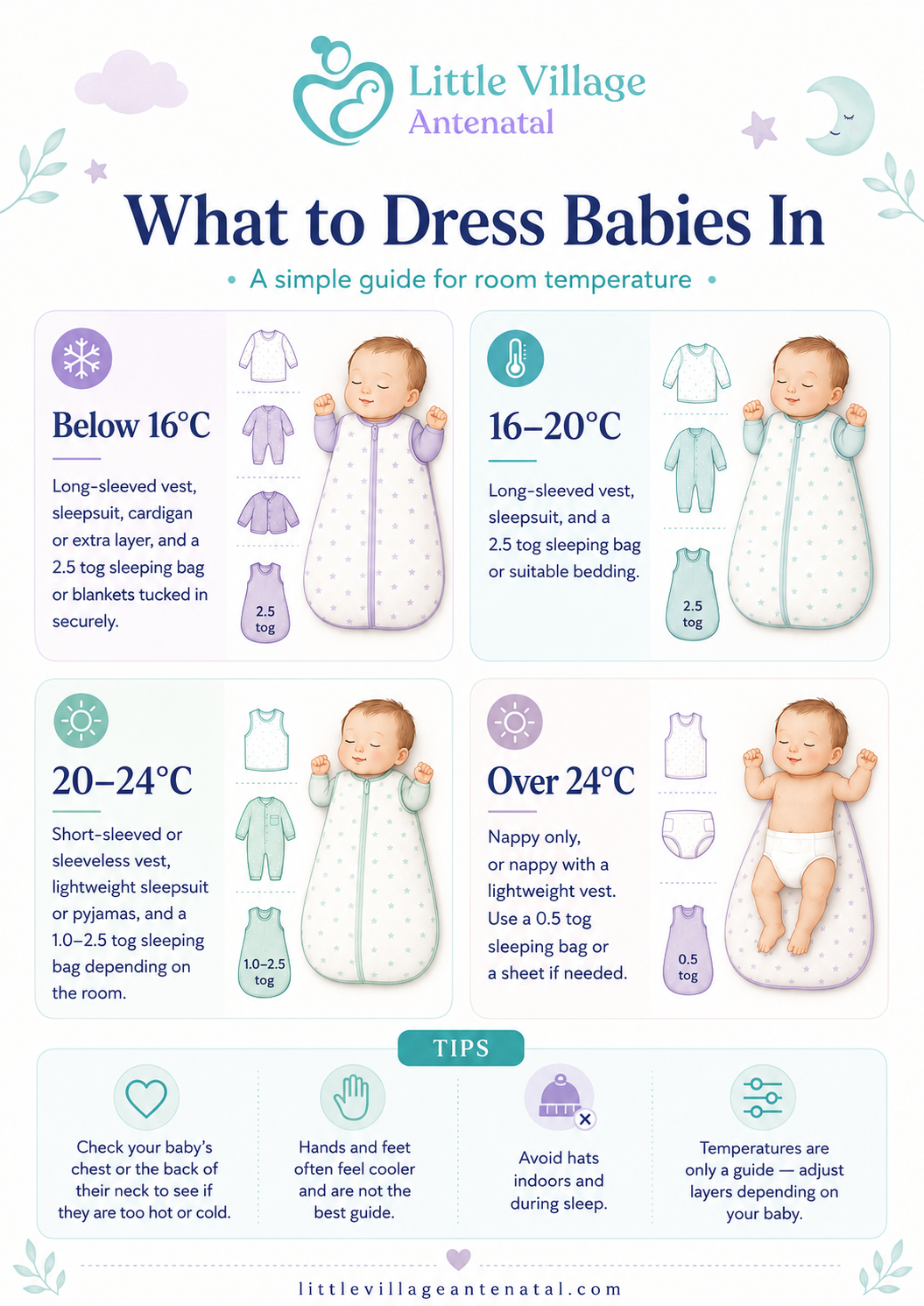
What should I dress my baby in?
A simple baby clothing and sleepwear guide to help parents choose safe, comfortable layers for different room temperatures.
Do not use a fan aimed directly at a sleeping baby. Circulate air in the room rather than pointing the fan at your baby.
Check your baby more frequently during hot nights. Feel the back of their neck regularly to ensure they are not overheating.
Do not use cooling mattress pads or gel mats in the sleep space. These are not designed for overnight unsupervised use and have not been tested for safety in the sleep environment.
The sleep surface should always be firm and flat. This is especially important in hot weather when parents may be tempted to move babies to sofas, beanbags, or other surfaces that seem cooler but are not safe.
Feeding in Hot Weather
Breastfed Babies
If you are breastfeeding, your baby does not need water, even in very hot weather. Breast milk is over 80% water and adapts to your baby's needs, providing extra hydration when they need it. Your baby may want to feed more frequently in hot weather, and this is normal and should be encouraged. Let your baby lead, as frequent feeding in hot weather is their way of getting the extra fluid they need.
Make sure you are staying well hydrated yourself. Breastfeeding increases your fluid requirements, and if you are also losing fluid through sweating in hot weather, your need for fluids increases further.
Formula-Fed Babies
Formula-fed babies under six months do not need additional water as a general rule, but in very hot weather a small amount of cooled, boiled water (around 30 to 60ml) can be offered between feeds. Speak to your health visitor or GP if you are unsure about your individual baby's needs.
Babies Over Six Months Who Are Weaning
Once your baby has started solid foods, which is recommended from around six months, they can be offered cooled, boiled water with and between meals. In hot weather, offer water more frequently. Cool, water-rich foods such as cucumber, melon, and yoghurt can also contribute to hydration.
Signs of Dehydration in Babies
Fewer wet nappies than usual (less than six in 24 hours is concerning)
Dark, strong-smelling urine
A dry mouth
No tears when crying
Sunken fontanelle
Lethargy or unusual drowsiness
Dehydration in a young baby requires prompt medical attention. Contact your GP, call 111, or go to A&E if you are concerned.
Sun Safety for Babies
Babies Under Six Months
The NHS and Cancer Research UK advise that babies under six months should be kept out of direct sunlight altogether. Their skin is extremely sensitive, the melanin that provides some natural protection from UV rays is not fully developed, and sunscreen is not recommended for this age group.
This means keeping your baby in the shade at all times outdoors and avoiding the sun between 11am and 3pm entirely. If you are outdoors during these hours, ensure your baby is in deep shade. Use a sun canopy on your pram, but ensure there is still adequate airflow. Dress your baby in a sun hat with a wide brim that shades the face, neck, and ears when outdoors.
An important warning about prams in sunlight. Research has shown that covering a pram with a muslin or blanket to block the sun can raise the temperature inside the pram dramatically, from around 22°C to over 34°C within just 30 minutes. This is extremely dangerous. Always use a purpose-made parasol or shade cover that allows airflow, and check the temperature inside the pram regularly.
Babies Over Six Months
From six months, babies can begin to use sunscreen. Use a high-factor, broad-spectrum sunscreen designed for babies and young children, specifically SPF 50 with a five-star UVA rating. Apply generously to all exposed areas including the face, backs of hands, and tops of feet, and reapply every two hours and after water exposure.
Sun protective clothing such as UV-rated swimwear and rash vests provides excellent coverage and reduces the amount of sunscreen needed.
A wide-brimmed sun hat that covers the ears and neck remains essential.
Even with sunscreen, avoid direct exposure during peak UV hours between 11am and 3pm as much as possible.
Getting Around in Hot Weather
Car Travel
Car interiors can heat up to dangerous temperatures very rapidly in sunlight. Before placing your baby in a car seat, check that the car seat itself, particularly the metal parts of the buckle, has not become too hot to touch. Cool the car down before putting your baby in it if possible.
Fit window sunshades on the rear windows to reduce direct sunlight on your baby during travel. Keep the air conditioning running or windows open during journeys. Never leave your baby alone in a parked car, even for a moment and even in mild weather.
Prams and Slings
Prams in full sun can heat up quickly. Keep your pram in the shade and use a parasol. Check the temperature inside the pram regularly. It should feel comfortably warm, not hot. Never cover a pram with a muslin or blanket; use a ventilated sun shade instead.
Slings and baby carriers keep your baby very close to your body, which means they share your body heat. In hot weather, use lightweight, breathable sling fabrics and dress both yourself and your baby minimally. Check regularly that your baby is not overheating and that their face is visible and airways are clear. Take regular breaks from the carrier in hot weather to allow your baby to cool.
Visit your local sling library for assistance with sling safety.
Keeping Cool at Night
Hot nights are often the most challenging aspect of a heatwave with a baby. Here are practical measures that genuinely help.
Freeze water bottles during the day and place them in the bedroom in the evening to absorb heat from the air. A bowl of ice water placed in front of a fan cools the air as it circulates. Cool the room during the morning by opening windows before the temperature rises, then closing them and drawing curtains during the hottest part of the day. Open windows again in the evening as soon as the outside temperature drops below the indoor temperature.
Give your baby a tepid bath before bedtime to bring their temperature down. Check the temperature of the cot mattress before putting your baby down, as mattresses can retain heat, and a breathable mattress cover helps with this.
Your Own Wellbeing in Hot Weather
It is easy to focus entirely on your baby during a heatwave and forget that you are also vulnerable to heat, particularly if you are recovering from birth, breastfeeding, or sleep-deprived.
Breastfeeding mothers need significantly more fluid than usual. Aim for at least two to three litres of water per day in hot weather. Stay in the coolest part of the house when feeding. If you feel dizzy, faint, or very unwell in the heat, seek shade and fluids immediately and contact your GP if symptoms do not improve.
Postnatal recovery combined with sleep deprivation and heat is a genuinely challenging combination. Accept help, rest when you can, and look after yourself as well as your baby.
Quick Reference: Hot Weather Baby Safety at a Glance
Keep babies under six months out of direct sunlight entirely
Never leave your baby in a parked car
Dress your baby in lightweight, breathable layers appropriate for the room temperature
Use a 0.5 tog sleeping bag or nappy and muslin in very hot weather
Breastfed babies do not need extra water, but feed more frequently in the heat
Check for overheating by feeling the back of the neck, not the hands
Never cover a pram with a muslin or blanket; use a ventilated sun shade instead
Keep the bedroom cool using closed curtains during the day and open windows at night
Call 999 if your baby shows signs of heatstroke
From Little Village Antenatal
Keeping your baby safe through the seasons, including the increasing heat of UK summers, is something we cover as part of our newborn care content in our antenatal courses at Little Village Antenatal.
We run small, comprehensive courses from our base in Erith, serving families across Bexley, Dartford, Sidcup, Belvedere, and the wider Southeast London and Kent area. Our courses cover birth preparation, infant feeding, infant first aid, safe sleep, newborn care, and the postnatal period, with partners included throughout.
We are FEDANT registered (National Register Entry Number: 13969).
View our upcoming course dates and book your place here.
This blog is for informational purposes only and is not a substitute for advice from your health visitor, GP, or healthcare team. If you have any concerns about your baby's health in hot weather, always seek medical advice promptly. In an emergency, call 999.