
Am I In Labour? How to Recognise the Signs, A Complete Guide
Everything expectant parents need to know about the signs of labour, when to call your midwife, and what to do while you wait, from Little Village Antenatal, Erith
One of the questions we hear most in our antenatal courses is this one: "But how will I actually know I'm in labour?"
It's a completely reasonable thing to wonder. Films and television have done a terrible job of preparing people for what labour actually looks and feels like, the dramatic gush of waters, the immediate rush to hospital, the baby arriving twenty minutes later. For the vast majority of people, labour is nothing like that. It's slower, more gradual, and in the early stages, genuinely quite difficult to distinguish from the general discomforts of late pregnancy.
This guide covers everything you need to know, the early signs, the signs that things are progressing, the signs that mean call your midwife now, and what to actually do while labour is getting going. Because being prepared for this moment is one of the most valuable things you can do in the weeks before your due date.
First, What Is Labour?
Labour is the process by which your baby moves from the uterus, through the cervix and birth canal, and into the world. It involves three distinct stages:
First stage, the cervix dilates (opens) from 0 to 10 centimetres. This is the longest stage and is divided into early (latent) labour and established labour.
Second stage, the cervix is fully dilated and you push your baby out. This can take anywhere from a few minutes to a few hours.
Third stage, the delivery of the placenta, which usually happens within 30 to 60 minutes of the birth.
When people talk about "being in labour," they're usually referring to the first stage, the long process of the cervix opening. Understanding the difference between early labour and established labour is one of the most useful things you can know before the birth.
The Signs That Labour May Be Approaching, Days Before
These signs don't mean labour is imminent, but they do mean your body is preparing. They can happen days, or even a couple of weeks, before active labour begins.
The Show
One of the most well-known early signs of labour is the show, the loss of the mucus plug that has sealed the cervix throughout pregnancy. It typically appears as a blob or streaks of mucus that may be clear, pinkish, brownish, or blood-tinged. It can come away all at once or gradually over several days.
A show means your cervix is beginning to soften and change, which is a positive sign that your body is getting ready. However, it doesn't mean labour is about to start immediately. Some women lose their show several days before contractions begin.
You don't need to call your midwife when you have a show, unless you are also experiencing heavy, bright red bleeding, in which case contact your maternity unit straight away.
Lightening or Engagement
In the weeks before labour, your baby's head may descend into the pelvis, a process known as engagement or "lightening." You might notice that your bump looks different, lower, or more forward-pointing. You may find it easier to breathe as the baby drops away from your diaphragm, but you may need to wee more frequently as the pressure on your bladder increases.
In first-time parents, engagement often happens two to four weeks before labour. In women who have given birth before, it may not happen until labour itself begins.
Nesting
A sudden burst of energy and an overwhelming urge to clean, organise, and prepare everything in sight is a well-recognised pre-labour phenomenon. It can happen a few days before labour begins, or a few weeks, so don't take it as a reliable signal that birth is imminent. But do enjoy it, and try not to exhaust yourself in the process.
Loose Stools or an Upset Stomach
In the days before labour, the body releases prostaglandins, hormones that help ripen the cervix and stimulate uterine contractions. These same hormones can affect the bowel, causing loose stools, diarrhoea, or general digestive unsettledness. This is not glamorous, but it is completely normal and is the body's way of clearing the way for birth.
Increased Braxton Hicks
Braxton Hicks contractions, the irregular tightenings of the uterus that can be felt from the second trimester onwards, often become more frequent and stronger in the days before labour. They may feel uncomfortable but they don't follow a regular pattern, don't increase in intensity over time, and generally ease off when you change position or move around. This distinguishes them from true labour contractions.
Back Ache
A persistent, dull ache in the lower back that is different from your usual pregnancy backache can be an early sign that labour is approaching. It may be continuous rather than coming and going.
Leaking Colostrum
In the run-up to birth, some women notice drops of colostrum, the first milk, leaking from their nipples. This is completely normal and is not a sign that anything is wrong. It simply means your body is preparing to feed your baby.
The Signs That Labour Has Begun
Contractions
True labour contractions are the defining feature of established labour. Here's how to recognise them, and how to distinguish them from Braxton Hicks.
True labour contractions:
• Come at regular intervals that gradually get closer together
• Get longer in duration over time
• Get stronger in intensity over time
• Don't ease with movement, position changes, or a warm bath
• Are felt across the whole abdomen and often in the lower back
• Continue to build regardless of what you do
Braxton Hicks contractions:
• Come irregularly with no consistent pattern
• Don't increase in frequency or intensity over time
• Often ease or stop when you move around, change position, or have a drink of water
• Are more of a tightening sensation, often painless or mildly uncomfortable
• Usually felt at the front of the abdomen
In early labour, contractions may start mild and irregular, perhaps fifteen to twenty minutes apart, lasting thirty to forty seconds. Over time they will build in regularity, length, and intensity. This process can take many hours, particularly in a first labour.
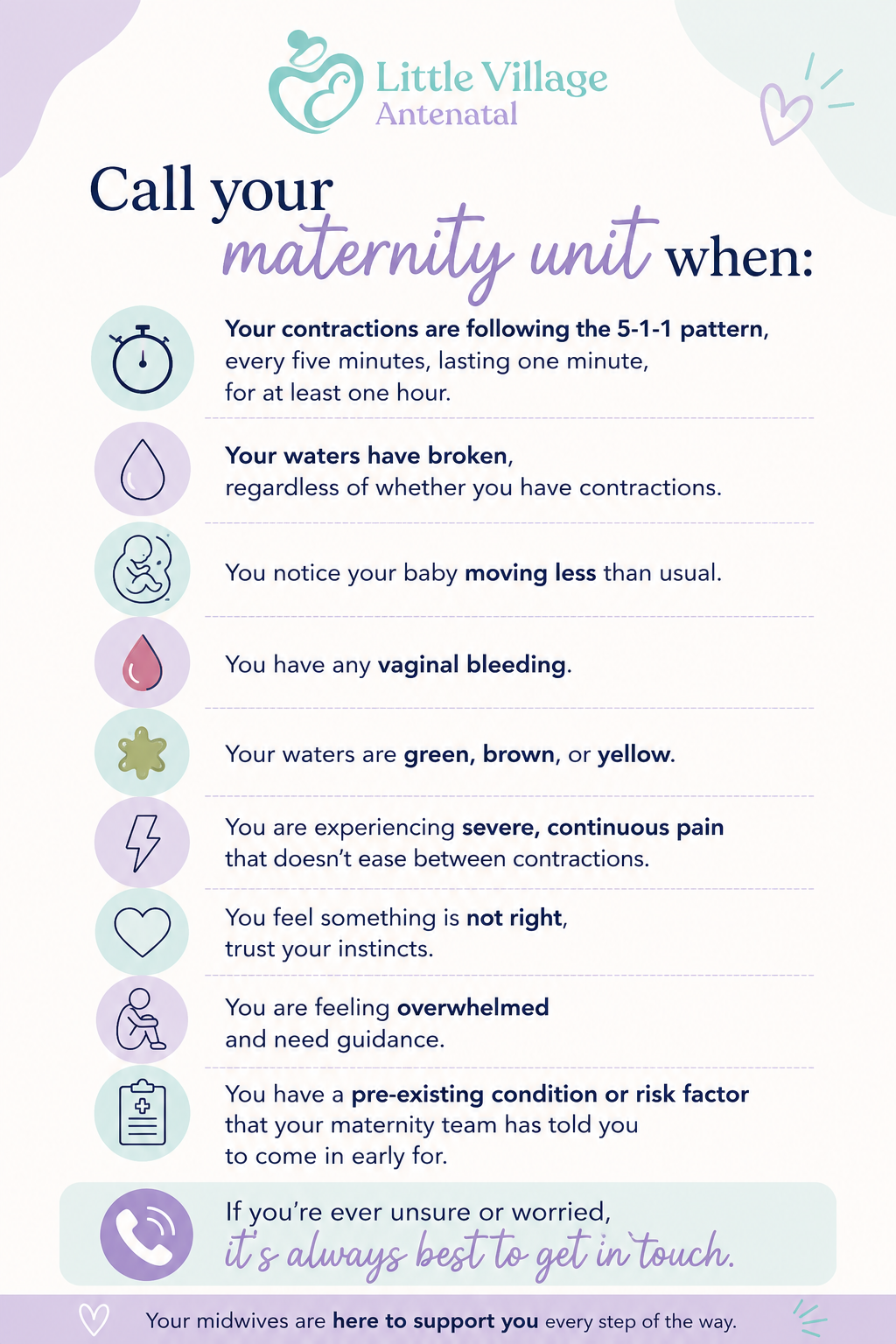
The 5-1-1 rule is a useful guide for when to call your maternity unit: contractions coming every 5 minutes, lasting at least 1 minute, for at least 1 hour. However, this is a guide, not a rule, always call if you're unsure, if you're feeling very overwhelmed, or if anything doesn't feel right.
What Do Contractions Feel Like?
This varies significantly from person to person and even from labour to labour. Common descriptions include:
• Intense period-like cramps, building in waves
• A tightening or squeezing sensation across the abdomen
• Pressure deep in the pelvis
• A wave of pain that builds to a peak and then fades
• Back pain that comes and goes in waves
The pain of a contraction is different from constant pain. A contraction builds, peaks, and releases, and between contractions, there is usually a period of rest. This is one of the things that distinguishes labour contractions from other types of pain.
Waters Breaking
Your baby develops inside a fluid-filled amniotic sac. When this sac ruptures, either before or during labour, the fluid is released. Contrary to popular belief, only around 10% of women start labour with their waters breaking. For most, the waters break during established labour, or are broken by a midwife as part of managing labour (a procedure called an artificial rupture of membranes, or ARM).
If your waters do break:
The fluid should be clear, pale pink, or slightly white. This is normal, it may contain traces of vernix (the white coating on your baby's skin) which can give it a milky appearance.
If the fluid is green, brown, or yellow, contact your maternity unit immediately. This can indicate that your baby has passed meconium (their first stool) in the womb, which requires prompt assessment.
Contact your maternity unit as soon as your waters break, even if you have no contractions. They will want to know when it happened, what the fluid looks and smells like, and will advise you on next steps. Most units will want to see you within a certain timeframe, usually 24 hours if labour hasn't started, due to the increased risk of infection once the sac has ruptured.
How do I know if my waters have broken? In late pregnancy it can genuinely be difficult to tell the difference between a trickle of amniotic fluid and a leaking bladder, both are common. If you're not sure, put on a fresh sanitary pad and lie down for twenty minutes. If the pad is wet when you stand up, it's more likely to be amniotic fluid (urine tends to stop when you lie down). Your maternity unit can also check for you.
Back Labour, What It Is and How to Cope
Back labour refers to labour where the pain is felt predominantly in the lower back rather than the abdomen. It's often associated with a posterior baby position, where the baby's back is facing the mother's back, putting the back of the baby's head against the mother's spine.
Back labour can be intense and is often described as a deep, relentless aching pressure in the lower back that is present between contractions as well as during them, unlike the wave-like pattern of typical contractions.
Coping strategies for back labour include:
• Being on all fours, this position takes the baby's weight off your spine and can help encourage the baby to rotate
• A birth partner applying firm counter-pressure to the lower back during contractions
• Using a birthing pool or warm shower, with water directed at the lower back
• Frequent position changes, movement can help encourage the baby to rotate to a more favourable position
• A TENS machine applied to the lower back
If you're experiencing back labour, tell your midwife, they can suggest additional support and help you find positions that give relief.
Early Labour, What To Do at Home
Unless you have a specific reason to go to hospital earlier (see below), you'll likely be encouraged to stay at home through early labour. This is not because your comfort doesn't matter, it's because for most people, being at home in a familiar environment, free to move around, eat, drink, and rest, leads to better outcomes than arriving at hospital too early.
Here's how to manage early labour at home:
Rest. If labour begins at night, which it often does, as the hormone oxytocin that drives contractions is produced more readily in darkness, try to rest between contractions, even if you can't sleep. Labour requires stamina. Don't exhaust yourself in the early hours.
Stay hydrated. Drink water regularly throughout labour. It's easy to become dehydrated, and dehydration can slow contractions and affect your energy levels. Light sports drinks can be helpful for maintaining energy.
Eat lightly. If you feel like eating, have something light and easily digestible, toast, banana, yoghurt. You'll need energy reserves, but a heavy meal can cause nausea as labour progresses.
Move around. Staying upright and mobile in early labour is beneficial, gravity helps your baby descend and can help contractions become more effective. Walk, sway, use a birth ball, find positions that feel comfortable.
Use the bath or shower. Warm water is remarkably effective at reducing the pain of contractions. A warm bath or shower can provide significant relief in early labour and is safe at this stage.
Use your TENS machine. If you have a TENS machine, early labour is the time to start using it, ideally before the contractions become intense, as the electrodes take a little time to build up their effect. Place the pads on your lower back and increase the intensity as contractions build.
Use breathing and relaxation techniques. If you've been practising breathing techniques from hypnobirthing or your antenatal course, now is the time to use them. Slow, focused breathing through contractions helps manage the intensity and keeps you calm.
Lean on your birth partner. Your birth partner's role in early labour is to help you stay calm, comfortable, and supported. Massage, counter-pressure, encouraging words, maintaining a calm environment, and keeping track of contraction timing are all valuable contributions.
Time your contractions. Use a contraction timing app on your phone, or simply note the time each contraction starts and ends. This gives you useful information to share with your midwife when you call.
Call your midwife if you're unsure. Your maternity unit has a triage line staffed around the clock. If you're unsure whether what you're experiencing is labour, how far along you are, or whether you should come in, call them. That's what they're there for. Don't feel embarrassed about calling.
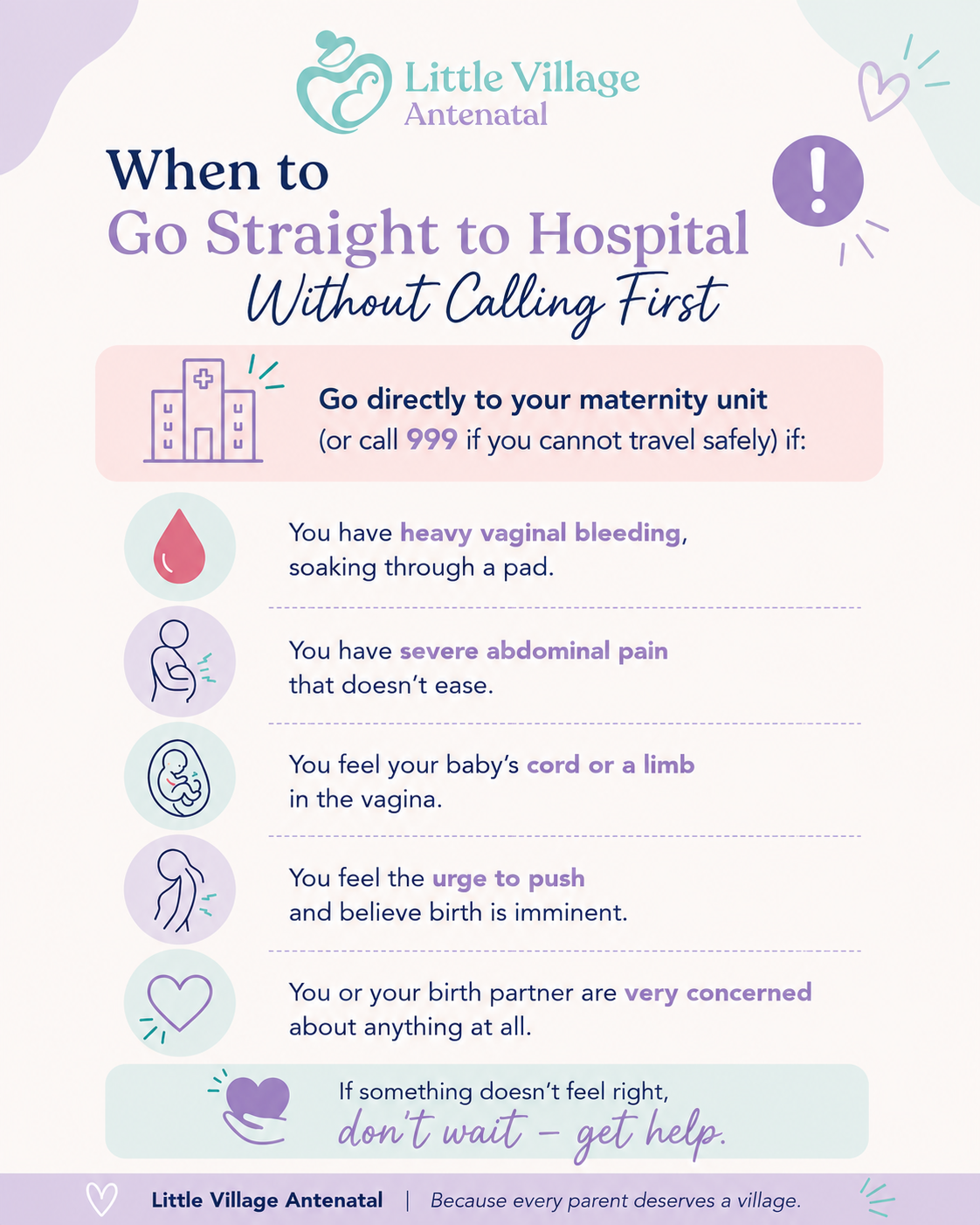
When to Call Your Midwife or Maternity Unit
What About Going Overdue?
Around one in five babies arrives after 41 weeks, and some pregnancies continue to 42 weeks. If you reach your due date without labour starting, your midwife will offer you increased monitoring, including more frequent appointments and an assessment of your baby's wellbeing.
At around 40 to 41 weeks, your midwife may offer you a membrane sweep, a procedure where a midwife or doctor uses a gloved finger to gently separate the membranes of the amniotic sac from the cervix. This can trigger the release of prostaglandins and encourage labour to begin. It can be uncomfortable but is generally quick. You may need more than one sweep.
If labour has not started by 41 to 42 weeks, you'll be offered induction of labour. This is a conversation worth having with your midwife in advance of your due date, understanding what induction involves, why it's offered, and what your options are means you can make an informed decision rather than encountering it for the first time under pressure.
A Note for Birth Partners
If you're supporting someone through labour, your role matters enormously, and it's worth thinking about in advance.
In early labour, your most important job is to help create a calm, safe environment and to be present. This might mean:
• Timing contractions and keeping a record
• Making sure the labouring person is eating, drinking, and resting between contractions
• Providing physical support, massage, counter-pressure on the lower back, helping them find comfortable positions
• Running a warm bath
• Keeping the atmosphere calm, low lighting, quiet music if helpful, minimal fuss
• Knowing the route to the hospital, where to park, and having the bag packed and ready
• Knowing the maternity unit number and being ready to call
In established labour, your role is to be your partner's advocate and anchor. Hold the birth plan. Know their preferences. Ask questions on their behalf if they can't. Stay calm, even if they're not. Your calm is contagious.
You don't have to have all the answers. You just have to be present.
We Cover This in Our Antenatal Courses
Recognising the signs of labour, knowing when to call your midwife, and understanding what to do in early labour are all covered in depth in our antenatal courses at Little Village Antenatal. We work through the whole journey from the first signs to meeting your baby, including what happens if things don't go to plan, so that you arrive at labour feeling genuinely prepared rather than just hoping for the best.
Our courses are small, warm, and comprehensive, running from our base in Erith and serving families across Bexley, Dartford, Sidcup, Belvedere, and the wider Southeast London and Kent area. Partners are fully included throughout. We're FEDANT registered (National Register Entry Number: 13969).
View our upcoming course dates and book your place here.
Because the more you know, the calmer you'll be, and the calmer you are, the better labour tends to go.
This blog is for informational purposes only and does not replace the advice of your midwife or maternity team. If you are ever unsure whether you are in labour, or if you have any concerns at all about your health or your baby's wellbeing, always contact your maternity unit or midwife. In an emergency, call 999.